Bogotá: Things to Do, Places to Visit & Travel Guide to Colombia's Capital
Bogotá welcomes thousands of travelers every year for its history, culture and entertainment.
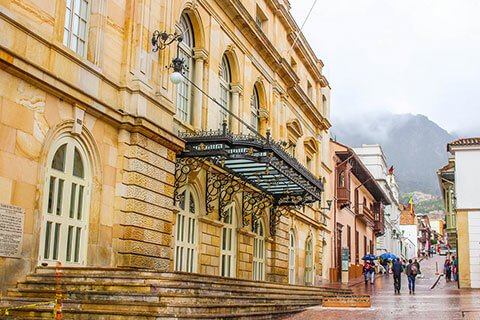
Bogotá is one of the most dynamic capitals in Latin America, with a wide choice of leisure, culture and shopping.
The city sits on the high Cundiboyacense plateau at 2,640 meters above sea level. The average temperature is around 14 °C (57 °F), with mild days and cool nights.
How to get to Bogotá
Bogotá is served by El Dorado International Airport, with domestic and international flights. It is the busiest and best-connected airport in Colombia.
For those traveling by bus, the city has a large bus terminal on its western side, with departures to the whole country.
Other access routes are the main highways, such as the Medellín–Bogotá highway, the Northern Highway, La Calera and the Southern Highway.

Travel information
Bogotá is packed with attractions that make it a great destination for a holiday.
The city has solid infrastructure for welcoming visitors from all over the world.
Accommodation ranges from luxury international chains to cozy guesthouses and budget hostels.
Bogotá also stands out for its varied food scene, with both international restaurants and local Colombian cuisine.
Nightlife is lively: bars and clubs across the city draw thousands of locals and visitors every night.
Getting around Bogotá
Several transit options cover the city. The standout is TransMilenio, a network of red articulated buses running on dedicated lanes with set stations. This mass-transit system has been praised by urban planners and served as a model for similar systems in other cities worldwide.
Another Bogotá trademark is the ciclovía: on Sundays and public holidays, long stretches of road close to traffic so thousands of people can cycle along routes across the city.
Taxis and city buses round out the capital's transport options.

Places to visit
Plaza de Bolívar
Plaza de Bolívar is the political and historic heart of Colombia and Bogotá's main square. Around it stand the city's most important buildings: the Palace of Justice, the National Capitol, the Cathedral, the Casa del Cabildo Eclesiástico, the Archbishop's Palace and the Liévano Palace, seat of the Mayor's Office of Bogotá.
The Cathedral
This is Colombia's principal church. The Metropolitan Basilica Cathedral of the Immaculate Conception was built between 1807 and 1823 by architect Domingo de Petrés. It is neoclassical in style, with a high altar and fourteen smaller chapels inside.
La Candelaria neighborhood
La Candelaria is Bogotá's most characteristic district and its historic center, still lined with colonial buildings. Set beside Plaza de Bolívar, it is full of cultural venues, along with bars popular with students and a bohemian crowd.
Colón Theater
The Colón Theater is Bogotá's leading theater, in the historic center. Built in 1885, it preserves the materials and detailing of the era and is a declared National Monument well worth a visit. Address: Calle 10 # 5-32. Phone: +57 (1) 381 6380.
Top sights in Bogotá
Monserrate Hill
Monserrate is Bogotá's most famous hill, visible from many parts of the city, rising to 3,152 meters. At its summit stands the sanctuary of the Fallen Christ, where thousands of pilgrims arrive each year.
You can reach the top on foot along the pilgrims' Via Crucis path, or by a modern funicular or a panoramic cable car.
Usaquén
Usaquén is a charming district known for its well-preserved colonial buildings. It is full of bars and restaurants, so its streets come alive at night, and every Sunday morning it hosts the flea market, where all sorts of curious objects are bought and sold.
Zona Rosa, Parque de la 93 and Zona T
These areas hold most of the city's restaurants, bars and nightlife. Every night — especially Thursday to Saturday — thousands of people come out to enjoy themselves, and many of the trendiest spots are here.
Museums in Bogotá
Bogotá is remarkably rich in museums. It is well worth visiting these places, which preserve the cultural, artistic and historic heritage of the city and of Colombia.
Gold Museum
The Gold Museum (Museo del Oro) is without doubt the most famous and most visited museum in Bogotá. Run by the Bank of the Republic of Colombia, it displays the most complete collection of gold work in the world, made up of objects from various pre-Columbian cultures.
Address: Carrera 6 #15-88.
Phone: (571) 3432222
Hours: Tuesday to Saturday, 9 am to 6 pm (last entry 7 pm). Sundays and holidays, 10 am to 4 pm (last entry 5 pm).
Closed Mondays, including public holidays.
Closed on January 1, Good Friday, May 1, and December 24, 25 and 31.
Admission: paid.
Link: Museo del Oro
National Museum of Colombia
The National Museum of Colombia is the essential place to learn about the country's history. Its halls bear witness to Colombia's past and host interesting temporary exhibitions and cultural events — recommended for any visitor who wants to understand Colombia and its people.
Address: Carrera 7 N. 28-66, Bogotá
Phone: (571) 381 6470
Hours: Tuesday to Saturday, 10 am to 6 pm. Sunday, 10 am to 5 pm.
Closed Mondays, including holidays.
Also closed on January 1, May 1 and December 25.
Admission: paid.
Website: museonacional.gov.co
Quinta de Bolívar Museum
The Quinta de Bolívar Museum occupies one of the city's loveliest buildings, with wide gardens and grand rooms, once the temporary home of Simón Bolívar. Inside, it preserves mementos of the Liberator's life.
Address: Calle 21 No. 4A-31 este, Bogotá.
Phone: (571) 342 4100
Hours: Tuesday to Friday, 9 am to 5 pm. Saturday and Sunday, 10 am to 4 pm.
Closed Mondays, including holidays.
Admission: paid. Free every Sunday.
Website: quintadebolivar.gov.co
Independence Museum - Casa del Florero
The Independence Museum stands on the very spot where Colombia's independence began in 1810. Inside it preserves objects, accounts and documents from the era of the fight for emancipation.
Address: Carrera 7 No. 11-28, Bogotá.
Phone: (571) 3424100 / 3816411
Hours: Tuesday to Friday, 9 am to 5 pm. Saturday and Sunday, 10 am to 4 pm. Closed Monday.
Admission: paid. Free every Sunday.
Website: museoindependencia.gov.co
Botero Museum
The Botero Museum holds an outstanding art collection donated by the Colombian painter and sculptor, with works by major artists such as Miró, Dalí, Chagall and Renoir, alongside a rich collection of Fernando Botero's own work. It is today one of Colombia's leading art museums.
Address: Calle 11 No. 4-41, Bogotá.
Phone: (571) 343 1111
Hours: Monday, Wednesday, Thursday, Friday and Saturday, 9 am to 7 pm. Sunday, 10 am to 5 pm. Closed Tuesday.
Admission: paid.
Link: Museo Botero
Museum of Modern Art of Bogotá (MAMBO)
The Museum of Modern Art of Bogotá has several halls for permanent and temporary collections, and runs a busy program of activities for all audiences.
Address: Calle 24 #6-00, Bogotá.
Phone: (571) 286 0466
Hours: Tuesday to Saturday, 10 am to 6 pm. Sunday, 12 pm to 5 pm. Closed Monday. Holidays: check the website.
Admission: paid.
Website: mambogota.com
Maloka
The interactive science museum Maloka has various halls where young and old learn through play.
Address: Carrera 68D No 24A-51, Bogotá.
Phone: (571) 427 2707
Hours: Tuesday to Friday, 8 am to 5 pm (ticket office closes 4 pm). Weekends and holidays, 10 am to 7 pm (ticket office closes 6 pm).
Admission: paid.
Website: maloka.org
Parks in Bogotá
Simón Bolívar Park
Simón Bolívar Park is Bogotá's most iconic park. Covering 400 hectares, it has event plazas, lakes and open spaces. Location: Transversal 48 and Carrera 68, between Calles 63 and 53.
José Celestino Mutis Botanical Garden
The José Celestino Mutis Botanical Garden is a rewarding visit for anyone keen to learn about plants and trees, with species from Colombia's many different environments.
National Park
The National Park lies in the heart of the city, with sports facilities and walking paths.
Salt Cathedral of Zipaquirá
The town of Zipaquirá is 50 km from Bogotá. Thousands of travelers come to see the remarkable Salt Cathedral, a one-of-a-kind structure in the world: a great cathedral carved entirely from salt blocks inside an underground salt mine. Highlights include the Via Crucis, sacred figures and the high altar with a 16-meter cross.
Address: Carrera 6 Calle 1, Zipaquirá. Phone: 315 760 7376. Email: social@catedraldesal.gov.co
How to get to the Salt Cathedral
By bus from the bus terminal: at the Diagonal 23 No. 69-55 terminal (Salitre area), go to the red module (3) and take the bus to Zipaquirá. Buses run every 45 minutes; the trip takes 1.5 to 2 hours.
By TransMilenio: take any service to Portal Norte, then go to the intercity module for Zipaquirá (Platform 2, south zone, marked "Zipa" on the buses). Departures every 15 minutes.
By tourist train: the train leaves from the Sabana Station (Calle 13 with Carrera 18) and runs through Usaquén, La Caro and Cajicá to Zipaquirá. Check schedules and prices at turistren.com.co
Frequently asked questions about Bogotá
Bogotá sits at 2,640 m above sea level, with an average temperature of about 14 °C (57 °F), mild days and cool nights. Bring a jacket and something waterproof.
Through El Dorado International Airport, the busiest and best-connected in Colombia, with domestic and international flights. By bus it is served by the terminal on the west side of the city.
Explore La Candelaria (the historic center), go up Monserrate Hill, visit the Gold Museum and the Botero Museum, Plaza de Bolívar, and the Usaquén and Zona T districts.
The main system is TransMilenio (articulated buses on dedicated lanes), along with taxis and city buses. On Sundays and holidays the ciclovía opens hundreds of kilometers of roads for cycling.
The most popular are the Salt Cathedral of Zipaquirá, the Guatavita Lagoon and the towns of the savanna. Bogotá is also a base for traveling to Villa de Leyva and Boyacá.
The climate is stable all year. The driest seasons are usually December–March and July–August; in the rainier months (April–May and October–November) it's wise to bring an umbrella.